
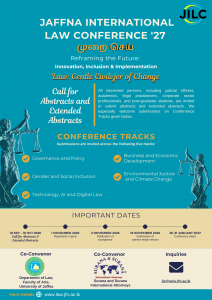
Jaffna International Law Conference ’27
Call for abstracts and extended abstracts
GENERAL GUIDELINES
- Abstracts and extended abstracts must be submitted in accordance with the submission procedures specified by the Conference Organisers.
- Submissions must be written in English.
- A submission may have a maximum of three authors: one main author and up to two co-authors.
- Each submission must clearly identify the selected conference track and demonstrate a meaningful connection with the central theme of the Conference, “Reframing the Future: Innovation, Inclusion & Implementation.”
- The submission should address a clearly identifiable legal or interdisciplinary research problem and demonstrate a clear research objective, argument, or contribution.
- Authors should preferably identify a gap in law, scholarship, policy, institutional practice, or implementation.
- Purely descriptive discussions of existing law should be avoided where the research does not develop a critical argument or contribution.
- Where comparative or international materials are used, their relevance to the research question should be clearly explained.
- Recommendations, where included, should follow logically from the analysis.
- Authors must ensure that their submissions are original and that all sources, quotations, ideas, data, legal authorities, and other materials are appropriately acknowledged.
- Submissions may be subject to academic review and originality/plagiarism screening in accordance with the procedures determined by the Conference Organisers.
- Authors whose submissions are accepted must comply with the requirements and deadlines communicated by the Conference Organisers for registration, presentation, and submission of the final/camera-ready version.
- Further requirements concerning AI-assisted writing, plagiarism screening, prior publication, multiple submissions, and authorship will apply once the organisers issue the detailed official instructions.
Guidelines for Abstract
- The abstract should not exceed 300 words.
- The abstract should provide a concise presentation of the proposed research and clearly communicate the research problem, relevance to the selected conference track, research objective, methodology, main argument or expected findings, and contribution/significance.
- The abstract should be written as one coherent text and should not contain separate internal headings.
- The abstract should clearly demonstrate the relevance of the research to the selected conference track.
- Footnotes and citations should not normally be included in the abstract unless specifically required by the Conference Organisers.
- The abstract should be sufficiently focused to communicate the research idea clearly without becoming a full research paper.
- The abstract should be prepared in Times New Roman, 12 pt, double-spaced, and justified, on A4 paper with recommended 1-inch (2.54 cm) margins on all sides.
- Three to five keywords should be provided immediately below the abstract.
Guidelines for Extended Abstract
The extended abstract should provide a more developed presentation of the proposed research than a conventional abstract. It should enable reviewers to understand the research problem, objectives, methodology, relevant legal or theoretical framework, principal analysis, findings or expected findings, recommendations, and overall contribution of the research.
The extended abstract should provide sufficient information for a comprehensive academic assessment of the proposed research while remaining concise and focused.
- Length and General Requirements
- The extended abstract should normally be presented within two to four pages, including references, figures, tables, and other permitted content.
- The extended abstract must be written in English.
- A maximum of three authors may be included in a submission.
- The submission must clearly identify the selected conference track.
- The extended abstract should demonstrate a clear connection with the central conference theme and the selected conference track.
- The extended abstract should present an identifiable research problem, research objective, methodology, argument, findings or expected findings, and contribution.
- Authors should preferably identify a gap in law, scholarship, policy, institutional practice, or implementation.
- The discussion should go beyond a merely descriptive account of existing law and should demonstrate critical analysis and an identifiable contribution.
- Formatting Requirements
The extended abstract should follow these formatting requirements:
| Item | Requirement |
| Language | English |
| Page length, where applicable | 2–4 pages including references |
| Font | Times New Roman |
| Font size | 12 pt |
| Line spacing | Double |
| Alignment | Justified |
| Paper size | A4 |
| Margins | 1 inch (2.54 cm) |
| Maximum authors | 3 |
| Keywords | 3–5 |
| Figures/tables | Maximum 2 |
| Referencing | OSCOLA 4th edition, where required |
Template—Abstract and Extended Abstract
 Loading...

 Reload document
 Open in new tab